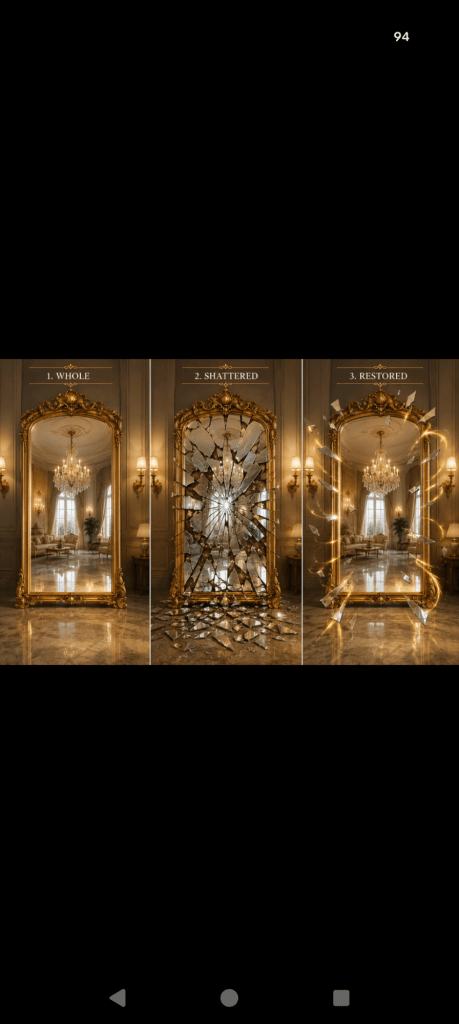
The three mirrors represent three different levels of understanding reality.
The second picture is the world as it naturally appears to human beings. Everything looks shattered, separate, and disconnected. People appear to live independent lives. Nations rise and fall. Animals, birds, plants, and human beings all seem to exist within their own separate worlds. Wealth, poverty, sickness, health, success, failure, joy, and suffering appear to be unrelated events.
This is how the physical world was created to look.
The Creator placed us into a world in which unity is hidden. Everything appears divided into countless individual pieces. Each person sees only one small fragment and often assumes that this fragment is the entire picture.
But the separation is only external.
In reality, all of creation is bound together. Every person, animal, bird, plant, event, and movement in the world is connected within one complete system. Nothing exists independently. Nothing happens outside the will and knowledge of Hashem. What appears random and fragmented is actually part of one continuous Divine order.
The first picture represents reality as it truly is. The mirror is complete because creation is complete. Every piece has its place. Every event has a purpose. Every creature has a function. The unity may be hidden from the human eye, but it remains the deeper truth of existence.
The third picture represents the work of Torah.
Through Torah study, mitzvos, prayer, reflection, and proper understanding, a person slowly takes the broken pieces and places them back together. The world itself does not change. What changes is the way the person sees the world.
Torah trains the mind to move beyond the external picture of separation. It teaches a person to recognize connections where others see only accidents. It teaches him to see purpose where others see confusion, order where others see chaos, and Divine direction where others see only nature and chance.
This is one of the central differences between the Jewish people and the nations of the world.
The natural worldview accepts the second picture as the final reality. It studies each piece separately. It examines nature, society, economics, psychology, politics, animals, and human behavior as independent systems. Even when connections are discovered, the world generally continues searching within the broken mirror itself.
The Torah-trained Jew is expected to see deeper.
When a Jew is properly tuned to Torah and concentrates on its teachings, he begins to see both the first picture and the third. He understands that reality is united, and he also understands that the purpose of life is to restore that vision within himself.
This does not mean that every Jew automatically sees the complete picture. A person can possess Torah and still think like the fragmented world. Torah must shape his mind, his values, his reactions, and his understanding of events. Only then does he begin to see the pieces returning to their proper place.
The difference is not merely knowledge. It is vision.
The ordinary eye sees many separate creatures. Torah sees one creation.
The ordinary eye sees unrelated events. Torah sees Divine providence.
The ordinary eye sees competing forces. Torah sees different instruments serving one purpose.
The ordinary eye sees a shattered mirror. Torah teaches a person how to recognize the whole mirror that exists behind the shattered appearance.
Picture Two is the world as it appears.
Picture One is the world as it truly is.
Picture Three is the lifelong process through which Torah restores a person’s ability to see that truth.
The world continues to insist that the broken pieces are the full reality. The Torah teaches that they are only fragments of one complete picture.


Leave a Reply