Imagine that the entire universe is filled with an endless, thick foam. Every person must walk through it. The foam represents existence itself, surrounding everything and everyone.
1. The First Traveler
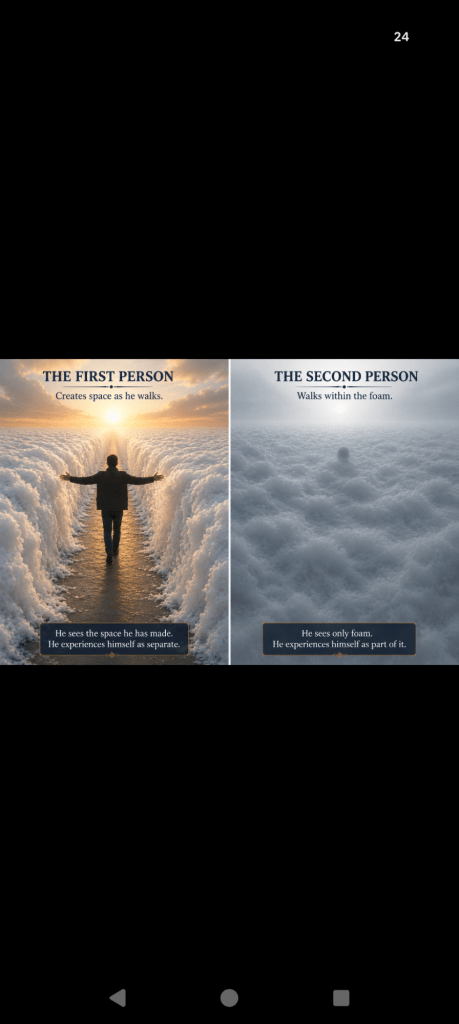
The first person walks through the foam and pushes it aside. His body, his arms, and everything he carries force the foam away from him. As he moves, he leaves behind a wake that perfectly matches the contours of his body. Wherever he goes, a space is created.
Looking around, he sees the opening he has made. He experiences himself as someone separate from the world. His identity is measured by what he has carved out, acquired, controlled, and influenced. The larger the opening, the greater his feeling of independence.
2. The Second Traveler
Now imagine another person walking through that very same foam.
Yet something is entirely different.
The foam never separates from him. No matter where he walks, all he sees is foam. It surrounds him in front, behind, above, and below. It is as though he himself belongs within it. He does not experience himself as separate from creation.
Through deep thought and study, he understands that his existence is completely integrated with the Creator’s will. Every breath, every thought, every ability, and every success are continuously sustained by God.
This second traveler also represents the Jewish people. Having received the Torah, they were placed in the service of the Creator. Every action, every mitzvah, every decision, and every moment of life is meant to be connected to God’s will. Their purpose is not to create an independent existence but to recognize that everything belongs to the Creator.
3. The Great Challenge
The second traveler faces the greater challenge.
Outwardly, he appears no different from the first traveler. As he walks, he also sees what appears to be space surrounding his body. His eyes tell him that he, too, is pushing the foam aside and creating an opening as he moves.
Yet the Torah teaches him not to trust appearances alone.
His task is to look beyond what his senses report and instead focus on the foam itself. He knows that it surrounds him completely—before him, behind him, above him, and beneath him. It protects him, sustains him, and remains with him every moment of his life. Whatever space seems to exist around him is not truly separate from the foam. It is still part of it.
Likewise, whatever a person builds, earns, invents, or accomplishes never becomes independent of the Creator. Every success, every possession, every ability, and every achievement remain completely integrated within God’s world and continuously depend upon Him for their existence.
He looks around and sees others who appear to create large spaces for themselves. They seem independent, powerful, and self-made. Compared to them, he may appear insignificant.
His test is not to imitate them. His challenge is to ignore the illusion of independence and remain faithful to the deeper reality. True greatness is not measured by how much space a person appears to occupy, but by how deeply he understands that he has never stepped outside the Creator’s world.
The first traveler says:
“Look at the space I have created.”
The second traveler quietly answers:
“Everything I have done remains within the Creator’s foam. I have never left His presence.”
—
Sidebar 1: The Matrix as an Analogy
became a cult classic because it asks whether the visible world is the whole reality. In the film, people unknowingly live inside a simulated world while a deeper reality exists behind it. As Neo’s understanding grows, he realizes that appearances are only a layer covering something deeper.
This serves as a useful analogy. Torah also teaches that the physical world is not the whole of reality. The essential difference is that behind creation is not computer code or machines, but the Creator Himself, Who continuously sustains all existence.
—
Sidebar 2: The Invisible Connection
A human being appears completely independent. He thinks, speaks, and acts without any visible connection to an outside source.
Modern technology helps us understand an ancient truth. We know that a phone receives information through invisible Wi-Fi signals. We cannot see the signal, yet we know there is a source, a server, and a constant flow of information. If someone living only a few hundred years ago had witnessed wireless technology for the first time, he would likely have regarded it as something beyond comprehension because the connection itself cannot be seen.
Our own existence is remarkably similar. We do not see the Source that gives us life, consciousness, intelligence, memory, imagination, or the ability to choose. Yet if, from our youth, we ask the deepest questions—How do I exist? Why am I conscious? Where do my thoughts and abilities originate?—we begin searching for the Source behind those gifts.
The Torah teaches that the Source is the Creator. The server analogy is only an illustration: just as an unseen server continuously sustains every connected device, so too the Creator continuously gives existence to every human being and to the entire universe. Unlike a machine, however, the Creator is infinite, personal, and beyond creation itself.
Judaism therefore encourages not only faith, but questioning, learning, and understanding. A person is invited to investigate reality until he recognizes that every breath, every thought, every success, and every moment of existence continuously flow from the Creator.
The world belongs to Him, and the Torah is His guidebook for understanding and living within that reality.
—
Conclusion
Most people measure life by the space they believe they have created.
Torah teaches us to measure life by the One Who creates, sustains, and surrounds that space.
The deepest wisdom is not to become larger than the world, but to recognize that we have never existed outside the Creator’s world. Every step we take, every success we enjoy, and every accomplishment we achieve remain surrounded by His presence, sustained by His will, and integrated into His creation.
The more deeply a person understands this truth, the more humility, gratitude, faith, and purpose accompany every step of his journey.
—
Illustration
Place the split-panel illustration at the end of the article.
Left: The traveler leaves behind a wake that perfectly matches the contours of his body, symbolizing the perception of independence.


Leave a Reply